
A practical taurine document set for adult extruded dry cat food includes the target and reference edition, a finished-kibble test report when available, a comparison on a common basis, and a separate label review. Your team can use this checklist to identify what is ready and what is still missing:
- Specification: adult-maintenance extruded cat food, proposed taurine target, units, reporting basis and reference edition.
- Finished-kibble report: product and sample or lot identity, taurine result, units, reporting basis and analytical method.
- Comparison: target and result on matching bases, with the moisture, energy value and calculation used where needed.
- Label review: proposed declaration, destination country, product category, applicable source, check date and responsible reviewer.
Which taurine benchmark and basis apply?
A usable taurine benchmark identifies the profile edition, adult-maintenance extruded cat food entry, units and measurement basis. The product’s moisture and metabolizable-energy values support comparison with that reference; the historical profile does not establish the finished kibble’s taurine content. 1

The 2014 AAFCO Cat Food Nutrient Profiles give a taurine minimum of 0.10% on a dry-matter basis for adult-maintenance extruded cat food, with values premised on 4,000 kcal metabolizable energy (ME) per kg dry matter. I would identify the current edition and its adult-maintenance entry before treating this historical figure as a proposed contract target.
As-fed means the result includes the food’s water; dry matter (DM) expresses it with water excluded. ME is the energy value used in the calorie-based comparison. A result in mg/kg tells you the unit, but not whether the laboratory has reported it as-fed or on a dry-matter basis.
The calorie-based profile expresses the adult-maintenance extruded value as 25 mg/100 kcal. At 4,000 kcal/kg dry matter, that equals 1,000 mg/kg dry matter, or 0.10% dry matter. This equivalence uses matching mass bases; it does not convert an as-fed result to dry matter. The historical appendix calls for energy correction above its stated assumption, but not below it.
For the specification, place the proposed target, units, basis, reference edition and applicable adjustment note together. In the comparison record, retain the product’s moisture and energy values, their sources and the calculation used. Missing inputs leave the comparison incomplete; the profile assumption cannot stand in for the actual product energy value. 1
What evidence supports the finished kibble specification?
A finished-kibble report supports taurine review when it identifies the tested product or lot, result, units, reporting basis and method. The comparison must use the specification’s basis, and any missing field or result outside the agreed target needs a documented resolution before approval. 1
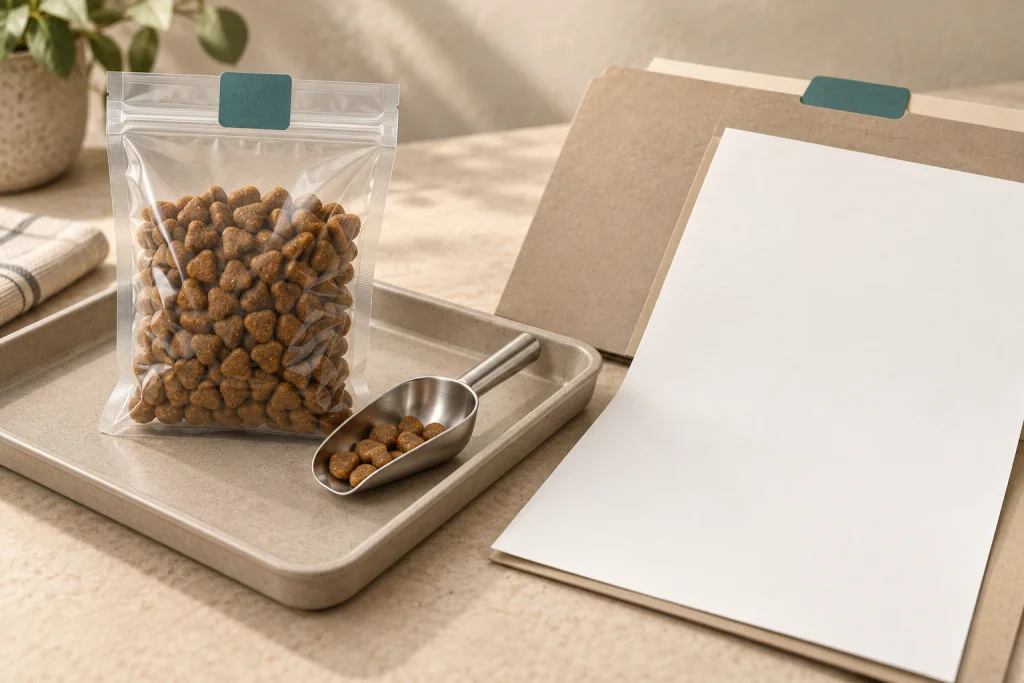
A formulated target records what the specification seeks; it does not show the taurine measured in finished kibble. Request a laboratory report tied to the proposed adult dry cat food and retain the sample or lot identity. A report for an unidentified sample leaves the link to your product unresolved.
I would separate a reporting gap from a result outside the agreed target. The next step depends on which problem remains:
| Finding | Next step and responsibility |
|---|---|
| Product, sample or lot identity is missing | Have your product team and manufacturer establish which product the sample represents. |
| Units, reporting basis or method are unclear | Ask the laboratory for the missing details and its assessment of method suitability for the submitted sample. |
| An as-fed result is paired with a dry-matter target | Obtain the finished-food moisture measurement and a documented dry-matter calculation from the laboratory or technical team. A result already reported on a dry-matter basis needs no further moisture conversion. |
| A comparable result remains outside the agreed target | Hold specification approval while your product team and manufacturer review the discrepancy with the laboratory and document the next action. |
In proposed order terms, specify who provides the sample, which sample or lot the report covers, when testing is required and who decides acceptance. These are terms for the parties to settle. The profile does not prescribe a universal certificate format or testing schedule, and it supplies no measured taurine result for a particular ZoePetSup product. 1
How should taurine label wording be reviewed?
Taurine label wording needs a separate review for the named destination country and adult dry cat food category. The review record should identify the proposed declaration, applicable rule, source and check date; a nutrient profile or laboratory result alone does not settle permitted wording. 1
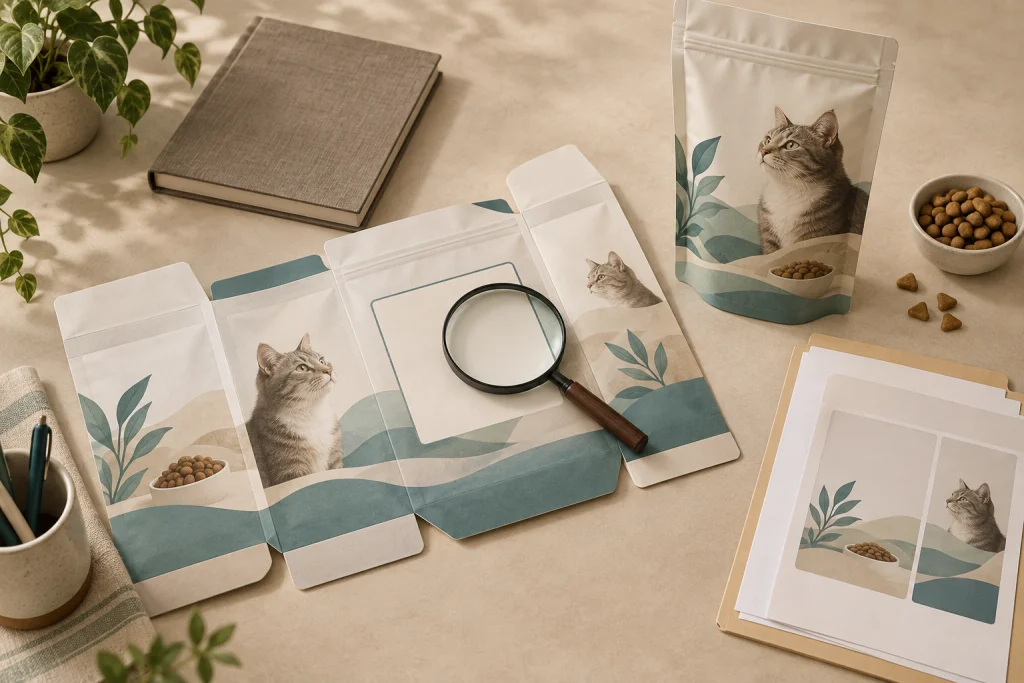
I would keep label approval separate from technical specification approval, so a satisfactory taurine comparison is not mistaken for permission to print a declaration. Use a label-review record with the proposed text, destination country, adult dry cat food category, applicable source, date checked and person responsible for the decision.
If the label includes a numeric taurine declaration, place its units and reporting basis beside the supporting finished-product result. A difference in basis goes back to the technical team for calculation; uncertainty about required or permitted wording goes to your regulatory adviser or the partner responsible for local label requirements.
The AAFCO profile supplies a nutrient reference, not a destination-country label decision. Keep the artwork open until the named reviewer records the wording decision and its basis. The final text and supporting product documents should remain together when your team authorizes printed packaging. 1
Conclusion
For an adult dry cat food OEM, private label or bulk inquiry, provide the destination country, sales channel, price positioning, pack sizes and expected quantity alongside the proposed taurine target, its reference edition, the product moisture and energy values used in the comparison, and any finished-kibble report. These inputs help distinguish a missing document from a result outside the target before specification approval. Finalize label wording after a dated check of the named country’s rule for adult dry cat food.
References
From research to a product brief
Explore the related OEM direction
Sensitive Stomach Cat Food OEM
Plan sensitive stomach cat food OEM development with ingredient traceability, sample criteria, label review and private label packaging requirements.
Explore this direction
Senior Cat Dry Food OEM & Private Label
A senior-cat dry food development direction for brands and importers planning a distinct range extension. Review the intended population, nutritional role, ingredient and flavour preferences, kibble, samples and pack formats before approving a commercial specification.
Explore this direction