Evaluate a small-breed extruded dry dog food sample by matching its identity and intended use to nutrition documents, measured kibble, eating-response observations, packaging and batch records. Approval applies to the specified candidate and the criteria your team sets for the proposed OEM, private-label or bulk product.
A practical review file starts with:
- ☐ The sample ID, formula version and batch identity or development status.
- ☐ The intended dogs, life stage, activity, feeding use and proposed energy value with its unit and reporting basis.
- ☐ The draft label and nutrient documents identifying the proposed food.
- ☐ Separate kibble measurements, appearance notes and dog eating-response records.
- ☐ The proposed pack, arrival condition, applicable batch records and unresolved items.
What defines a suitable small-breed sample?
A suitable sample has a defined small-breed life stage and feeding use, a proposed energy value, and a traceable formula and sample identity. Those fields make candidates comparable before nutrition, kibble, eating response and packaging results are judged. 12
Start by defining which dogs your product is meant to feed, their life stage and activity level, and whether the proposed food fits its intended feeding use. “Small-breed” alone does not identify a formula or establish that a particular sample suits those dogs. I would settle those fields before comparing candidates.
The proposed energy value belongs in the brief with its unit and reporting basis: it describes the energy in a stated quantity of food. Small dogs may need more calories per unit of body weight than larger dogs, but that observation supplies no energy target for this product. Values presented on different bases need a common basis before comparison.
Record the proposed formula direction and a sample identifier that appears on the material you receive and on its supporting documents. The file also needs the proposed pack size and whether the sample represents an identified production batch or a development version.
Different version details on the label, report and sample leave the candidate unclear. Ask the prospective supplier to identify which documents apply to the received sample. Until that link is clear, keep the affected result open; appearance cannot resolve a document mismatch. 12
Which nutrition documents support the proposed claims?
Nutrition review matches the draft label, life stage, feeding use and stated energy value to nutrient documents for the identified sample version. A guaranteed-analysis panel states nutrient guarantees; support for a nutritional adequacy claim remains a separate approval item. 34
I would keep the proposed label and the support for it as separate review items. A guaranteed analysis states declared nutrient minima or maxima, while a nutrient result reports a measurement for the identified food. Neither a formula direction nor the panel alone establishes nutritional adequacy for the stated life stage and feeding use.
The nutrition file needs the formula version, sample or batch ID, intended life stage, feeding use, stated energy value, draft label and product-specific nutrient results. Comparison requires matching nutrient names, units and reporting bases. A report for a different version needs an explanation of its applicability to this sample; an unexplained mismatch leaves the affected label wording open.
For dry dog food intended for the United States, AAFCO’s Reading Labels page, checked on 2026-09-29, identifies guaranteed-analysis fields including minimum crude protein, minimum crude fat and maximum crude fibre. The U.S. FDA’s Complete and Balanced Pet Food page, also checked on 2026-09-29, identifies meeting an AAFCO Dog Food Nutrient Profile as one route relevant to a complete-and-balanced claim. These references establish neither that this sample meets a nutrient profile nor market approval for a manufacturer.
Your review can assign the intended wording to your brand, the corresponding product records to the prospective supplier, and destination-specific label questions to a regulatory consultant. Those questions need a country-specific review for the proposed dry dog food; the United States references do not establish another country’s requirements. 34
How should kibble fit and acceptance be assessed?
Kibble assessment combines measured dimensions, shape consistency, hardness, bulk density and breakage with the intended small dogs’ observed eating response. Each result needs its own method and product-specific criteria, while your team’s appearance and odour notes remain separate. 5678

Begin with the intended dogs, because large pieces can present a choking concern for small dogs. That concern does not establish a universal diameter or prove that the smallest piece is the best choice. I would choose between candidate sizes using measured fit and eating observations.
The physical sheet can state the target dimensions and tolerance, measured range, shape consistency, hardness, bulk density, fines and broken pieces. Hardness describes resistance to breaking; bulk density describes the weight in a defined bulk volume. Fines are small fragments. Each attribute needs a named method, a unit where applicable and the criterion proposed for this product.
A tested formulation change affected hardness and density, as reported in a review of extruded dry pet food. That finding supports measuring a changed sample; it supplies no pass limits for your product. Reports using different methods need comparable measurements before their values can support a decision.
Keep your team’s colour, uniformity, surface and odour notes separate from the dogs’ eating record. Research on people’s responses to dry dog food found that visible attributes and kibble size affected liking, including a lower rating for products perceived as having pieces that were too small. Those observations concern people assessing food.
The dogs’ record should name the sample, intended dogs and life stage, feeding conditions, comparison method and observed eating response. A formulation change affected preference in tested extruded dry puppy food; that result cannot predict acceptance of this sample. In one comparison reported in the same review, dogs under 10 kg showed no significant preference between cross-shaped and round pieces. That result supplies no general shape rule.
If kibble falls outside an agreed physical criterion, identify the affected attribute and request a revised sample for that change. If eating response differs, review the observation method and sample identity before attributing the result to kibble size or shape. 5678
Which packaging and batch records matter?
Packaging review starts with arrival condition and continues with records for the proposed formula, pack and sampled batch. Seal performance, moisture, water activity, shelf-life support and batch results need identifiable documents; a sound-looking sample pack cannot establish those results. 910
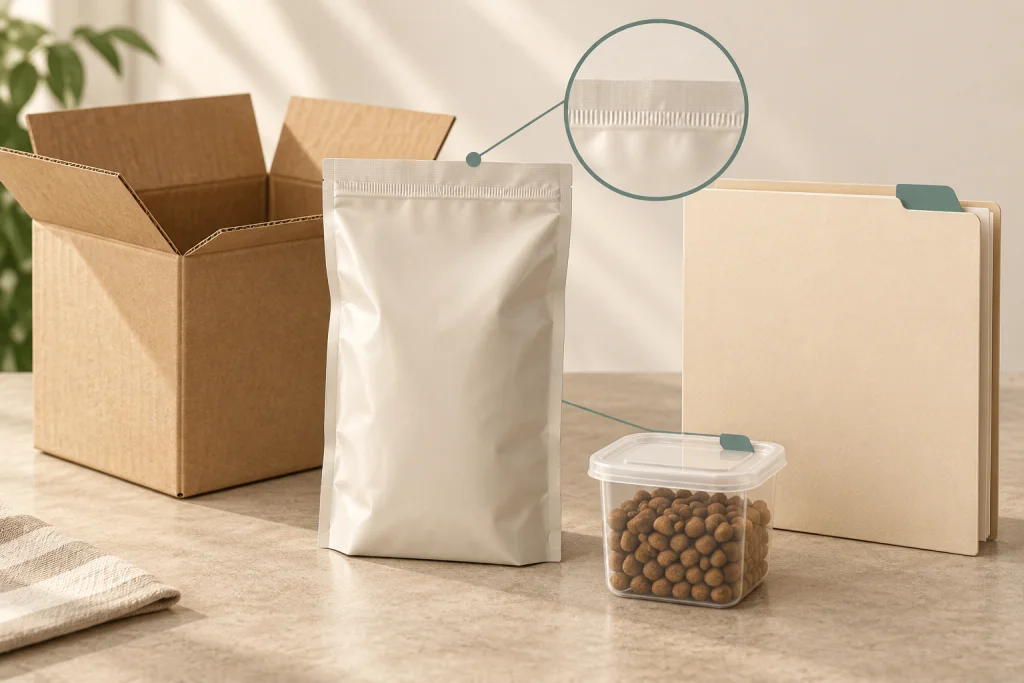
On arrival, record the pack identity, visible damage, seal condition and any obvious breakage or loose kibble. A photograph and brief note preserve what your team observed before opening the pack. A package that looks sound does not establish seal performance or support a proposed shelf-life statement.
The packaging file can identify the proposed formula, pack material, pack size and seal information alongside the relevant report or study. Moisture describes water content; water activity describes water availability. They belong in separate result fields, with the method and product-specific criterion shown. Seal, shelf-life and packaging-compatibility records also need to identify the formula and pack they cover. Results for a different combination need an explanation of their applicability.
For the sampled batch, the document request can include a finished-product certificate of analysis, nutrient and microbiological results, foreign-material checks, batch production records and traceability records. A certificate of analysis reports analysis results for the identified material; its title alone says nothing about which items were tested or what passed. Useful report fields include document ID, date, sample or batch ID, formula version, method, result and the criterion used.
The prospective supplier can identify which records belong to the sampled batch and which describe controls proposed for later production. Production quality controls and any feeding trials remain separate supplier-evaluation questions. A general control description cannot replace a result for this batch.
Your file can mark each requested record as received, pending or inapplicable with a reason. Where a required record is missing or refers to another version, the next step is the applicable document or a replacement sample, according to the unresolved issue. 910
How should sample approval criteria be recorded?
A useful approval sheet links each criterion to the sample version, method, result, supporting record and decision owner. It distinguishes approval from unresolved items or a required revised sample, and states how later batches will be compared with the retained reference. 89
I would keep one approval sheet for each sample version and leave the decision conditional wherever a required criterion lacks an applicable result. Each row needs the criterion, method or document, agreed limit where relevant, observed result, supporting record and named reviewer.
A compact decision table can make the next step explicit:
| Decision | Basis | Responsibility and next step |
|---|---|---|
| Approved | Required results and records meet the criteria for the identified version. | Your named approver records the accepted sample and document set. |
| Pending | A required result, record or version link remains unresolved. | The assigned reviewer names the missing item; the prospective supplier supplies the applicable record. |
| Revised sample required | A physical sample or proposed specification needs a change before approval. | The prospective supplier identifies the revised version; your team reviews the affected criteria. |
The sheet should identify the retained physical sample, associated documents and method for later batch comparison, including the agreed dimensional tolerance, bulk density, breakage and acceptable moisture variation. A later formula or pack change needs its own applicability decision for those records.
General nutritional and kibble findings explain what to examine. The proposed specification sets this product’s criteria, while accepted product and order documents record the commitments for the order. A general small-breed description supplies none of those product-specific limits. 89
Conclusion
A small-breed dry dog food sample is ready for approval when its identity, intended use, nutrient support, measured kibble, observed eating response, packaging and batch records meet the criteria for that proposed product. Keep the approved sample and decision sheet as the reference for comparing later batches.
For a related dry dog food inquiry with ZoePetSup, send the destination country, dog food category, sales channel, price positioning, proposed pack sizes and expected quantity, together with the intended dogs, life stage, feeding use and any criteria already set. These fields define the sample and accompanying records your team needs to assess.
References
- Evaluation of Pet Foods | Veterian Key. Retrieved 2026-09-29. ↩1 ↩2
- Best Dry Dog Foods in 2026, Recommended by Veterinarians | PetMD. Retrieved 2026-09-29. ↩1 ↩2
- Reading Labels | AAFCO. Retrieved 2026-09-29. ↩1 ↩2
- “Complete and Balanced” Pet Food | FDA. Retrieved 2026-09-29. ↩1 ↩2
- Best Dog Food: How to Know What's Right for Your Dog. Retrieved 2026-09-29. ↩1 ↩2
- Insights to Study, Understand and Manage Extruded Dry Pet Food Palatability - PMC. Retrieved 2026-09-29. ↩1 ↩2
- Consumer Acceptance of Dry Dog Food Variations - PMC. Retrieved 2026-09-29. ↩1 ↩2
- EASA Pet: Extrusion Technology in Dry Pet Food Manufacturing. Retrieved 2026-09-29. ↩1 ↩2 ↩3 ↩4
- EASA Pet: Dry Pet Food Quality and Documentation Guidance. Retrieved 2026-09-29. ↩1 ↩2 ↩3 ↩4
- NC State University Veterinary Hospital: Evaluating Pet Food. Retrieved 2026-09-29. ↩1 ↩2