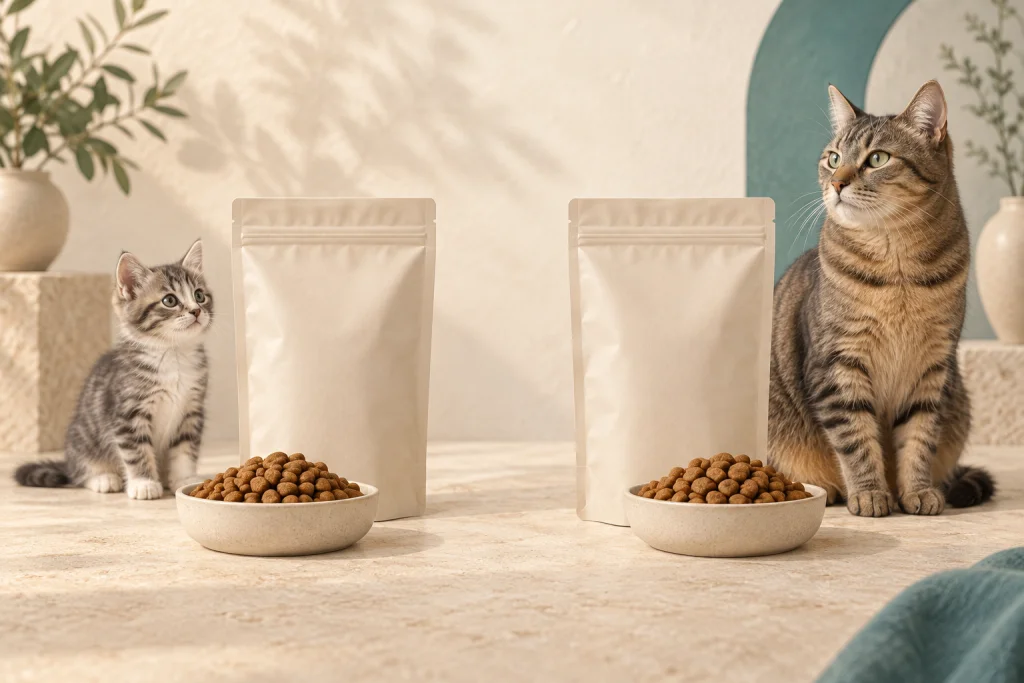
Your brand may position both kitten and adult dry cat kibble. Kitten products need a growth brief; adult products need a maintenance brief. Each life-stage description needs support from the proposed complete-food formula, while nutritional and kibble differences depend on the exact products being compared.
An early brief can use this checklist:
- Formula name or code, revision and intended life stage are listed together.
- Complete-food status, adequacy basis, nutrient analysis and energy value identify the same formula.
- Sample reference, kibble description and draft life-stage wording identify that product. 1
How do kitten and adult briefs differ?
Kitten kibble needs a growth brief, while adult kibble needs a maintenance brief. Each proposed complete food needs its own life-stage support; a product name or pack design cannot establish whether the formula supplies the nutrients required for that stage. 12
The AAFCO guide to selecting the right pet food says growing kittens need nutrient quantities and ratios different from mature pets. Growth is the kitten direction; maintenance describes the nutritional role for fully grown cats. Maintenance alone does not establish a body-weight outcome for a particular food.
AAFCO uses “complete” for a food containing all required nutrients and “balanced” for nutrients present in the correct ratios for its life stage and condition. The adequacy basis explains how the proposed food’s nutritional suitability for that stage is supported.
I would give each proposed extruded kibble formula its own intended life stage before comparing pack language. Your brief can place the formula code and revision beside the life stage, complete-food status, nutritional reference used and supporting documents.
The FEDIAF Nutritional Guidelines recommend chemical analysis of each finished product. That is general nutritional guidance, rather than a test record for a particular proposal. Your brand sets the intended product position; the manufacturer provides the formula information and finished-food analysis for nutritional assessment. 12
Which formula and kibble differences need verification?
Protein, fat, energy and kibble size are comparison fields, not automatic kitten-versus-adult differences. The exact proposed foods need matching reporting units and bases, while any smaller-piece description needs a finished kibble specification tied to the selected sample. 12
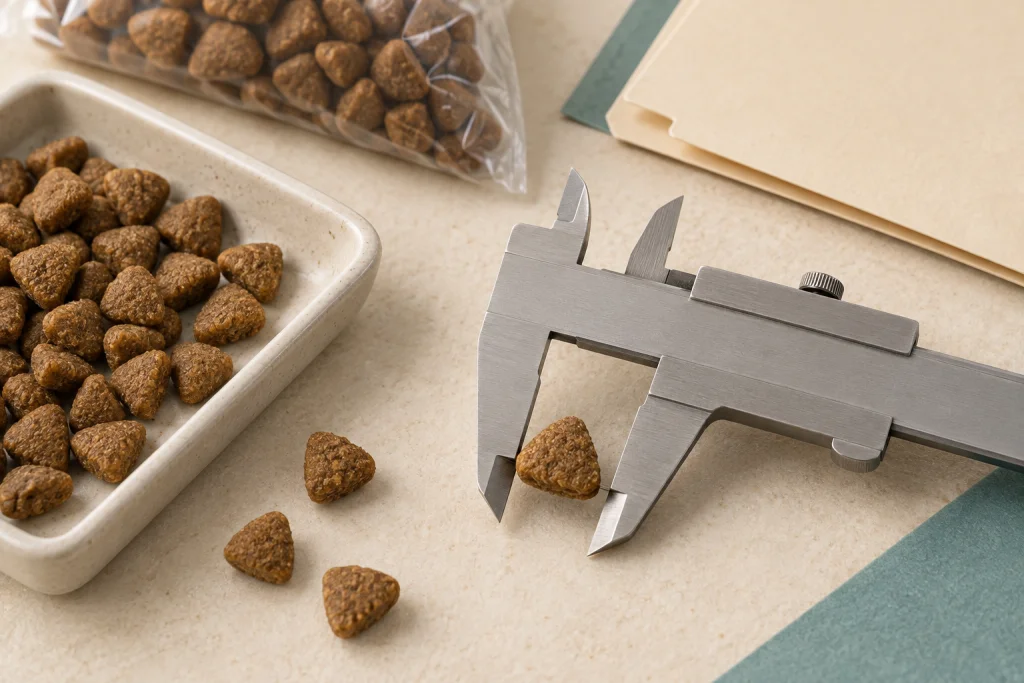
AAFCO describes calorie-rich foods designed for young animals. That background does not establish that a particular kitten proposal exceeds an adult proposal in energy, protein or fat. Energy density is the energy supplied by a stated amount of food. Higher figures alone do not establish suitability for growth.
I ask for the analyses and physical specification before describing one formula as richer or one kibble as smaller. Your comparison sheet can separate the following decisions:
| Record | Comparison fields | Next step after a mismatch |
|---|---|---|
| Nutrient analysis | Exact formula revision, protein and fat values, units and reporting basis | Obtain comparable results before using “higher protein” or “higher fat” wording. |
| Energy value | Energy per stated amount of food, with matching units for both formulas | Have the manufacturer restate an unclear value before ranking calorie density. |
| Finished kibble | Sample reference, dimensions and any texture description in the proposed specification | Resolve a sample/specification difference with a revised specification or a replacement sample before selection. |
A smaller kitten piece remains a proposed format until the sample and finished kibble specification support that description. The entries above are proposed comparison and order fields. Any intended product requirement belongs in the specification for the manufacturer’s acceptance; general life-stage guidance does not establish an order commitment. 12
When are all-life-stages claims supportable?
All life stages requires its own formula-specific nutritional support; adult-maintenance support alone does not establish suitability for growing kittens. Proposed pack wording needs both a nutritional basis for the stated stages and a separate review for the named destination country. 1
An adult-maintenance food should not be presented as suitable for growing kittens simply because both products are dry kibble. AAFCO lists growth, maintenance and all life stages separately, and relates complete-and-balanced nutrition to the stated stage and condition.
I would keep all-life-stages wording open when the formula documents support only adult maintenance. The nutritional assessment then needs to identify the missing life-stage support. Your brand can retain the adult position or request a revised formula proposal; a change in the pack name does not resolve a formula gap.
The label file can state the formula revision, intended stage, proposed nutritional wording, destination country and status of the country-specific review. Your team or regulatory consultant handles that wording review, while the manufacturer supplies the product details being assessed.
If the label describes growth while the nutrition file describes maintenance, the wording or formula proposal needs revision before packaging approval. The label, analysis and finished kibble specification need to identify the same product. General nutritional guidance does not establish permission to use particular pack wording in an unnamed country. 1
Conclusion
An OEM or private-label inquiry for separate kitten and adult packs can focus on the nutritional support for each stage and the sample format behind any stated kibble differences.
I start the brief with six inputs: destination country, dry cat food category, sales channel, price position, packaging sizes and expected quantity. Send those details with the intended life stage and any available formula or sample references for each product. They give us a basis to discuss formula direction, samples and packaging for the proposed product line.
References
From research to a product brief
Explore the related OEM direction
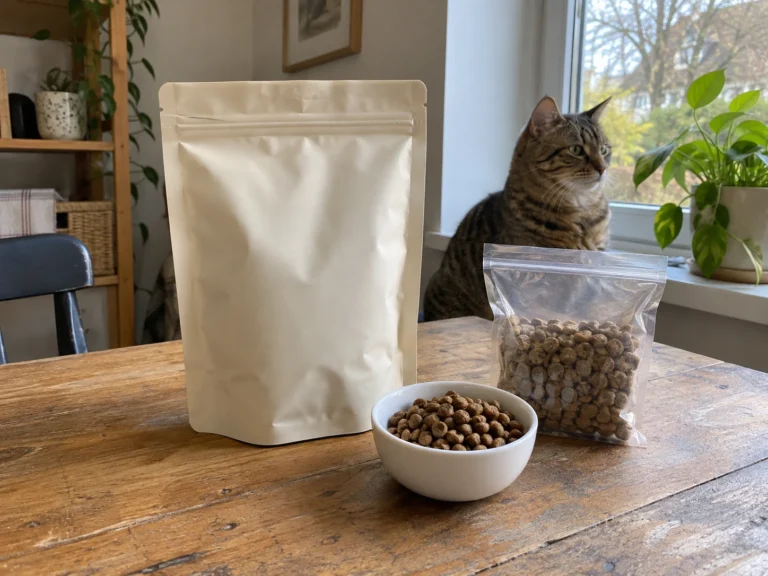
Indoor Cat Food OEM & Private Label
Plan an indoor cat food OEM SKU around positioning, formula questions, kibble samples and packaging. Send your private label project brief to ZoePetSup.
Explore this direction
Senior Cat Dry Food OEM & Private Label
A senior-cat dry food development direction for brands and importers planning a distinct range extension. Review the intended population, nutritional role, ingredient and flavour preferences, kibble, samples and pack formats before approving a commercial specification.
Explore this direction