A useful crude-protein specification for adult extruded dry dog food separates the formula target, measured product results and proposed label minimum. Your team needs the moisture basis beside each percentage and matching product records behind the proposed wording.
A practical specification checklist is:
- Product identity: adult-maintenance extruded dog kibble and formula version.
- Proposed specification: intended protein target and label minimum, each with its moisture basis.
- Laboratory record: sample or batch identifier, measured protein and moisture, reporting basis, analytical method and report date.
- Review record: applicable profile edition and footnotes, energy information, destination country and intended label wording. 1
What is the adult maintenance protein floor?
AAFCO’s historical adult-maintenance profile lists an 18.0% crude-protein minimum on a dry-matter basis, subject to its caloric-density conditions and footnotes. That reference does not set an adult kibble formula target or establish a product’s as-fed label minimum. 2

For your adult dry dog food brief, keep the profile reference, intended formula target and proposed label minimum separate. I would use the historical minimum to frame the formulation review, with the current applicable profile edition identified before selecting a product target.
The historical AAFCO profile appendix expresses nutrient concentrations on a dry-matter basis at a specified caloric density—the food’s energy content relative to its weight. It calls for correction for caloric content above its stated energy threshold before valid profile comparisons. Its footnotes contain information critical to interpreting the concentrations.
Your formulation review should therefore identify the adult-maintenance life stage, profile edition, energy value with units and relevant footnotes. An entry reading only “protein 18.0%” is incomplete: it leaves both the moisture basis and the purpose of the percentage unclear. The formulation team needs to supply those fields before the number can support a specification decision. 2
How does moisture change the protein comparison?
An as-fed protein percentage converts to dry matter by dividing it by the food’s dry-matter proportion. A useful comparison identifies the moisture value used and distinguishes measured sample results from calculations based on proposed label figures. 12
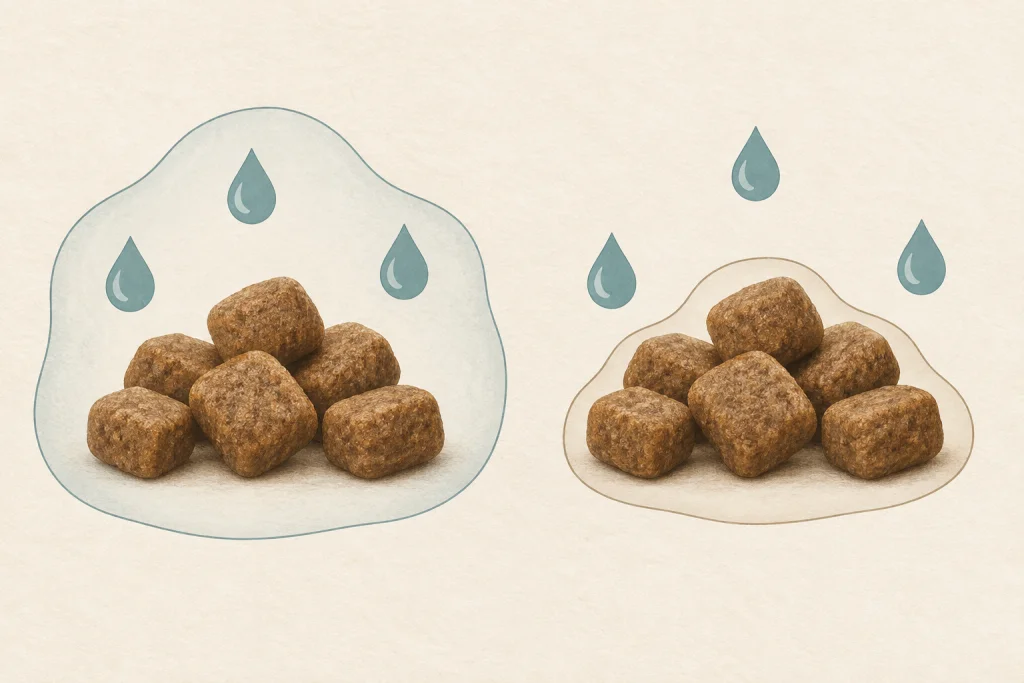
FDA’s explanation of moisture bases distinguishes dry matter, which excludes moisture, from as fed, which includes it. AAFCO’s historical appendix applies the conversion to both label guarantees and laboratory results reported as fed:
Dry-matter crude protein (%) = as-fed crude protein (%) ÷ [(100 − moisture (%)) ÷ 100].
I would pair measured protein with measured moisture from the same identified sample. The comparison sheet should retain both original results, their reporting basis and the calculated dry-matter value. The arithmetic example below uses assumed measurements.
For a proposed label guarantee, the sheet should also identify the moisture figure used and whether it is a measured value or a proposed label maximum. A calculation using proposed label figures remains distinct from an actual sample result. If the moisture value or reporting basis is missing, ask the report issuer for the missing field before interpreting the difference as a formulation problem. 12
Hypothetical moisture conversion: Assumed measured values: 20.0% crude protein as fed and 10.0% moisture. Dry-matter proportion: 0.90. Calculated crude protein: approximately 22.2% on a dry-matter basis. This is an arithmetic example, not a product result or proposed guarantee. 2
What supports a defensible label minimum?
A defensible proposed label minimum needs an identified adult formula, protein and moisture results on stated bases, the analytical method and relevant production results. The formula target, measured value and proposed guarantee remain separate entries in the specification. 123
I would assess your proposed minimum against results for the identified formula, rather than use the formula target as proof that the label wording is supported.
AAFCO’s label-reading guidance describes crude protein as a minimum guarantee. “Crude” refers to the analytical method: its example multiplies measured nitrogen by 6.25. The percentage alone does not establish overall adult-maintenance adequacy. FDA explains that meeting an AAFCO profile requires every listed nutrient at the recommended level; AAFCO’s formulation discussion also notes that concentration lists cannot ensure adequacy in every formula without additional considerations.
Use the specification review to resolve specific gaps:
| Finding | Next decision |
|---|---|
| The report names a different formula version or sample. | Obtain the matching report before using the result to support the proposed minimum. |
| A measured result is below the proposed minimum on the same basis. | Ask the formulation and quality teams to assess the discrepancy and determine whether further analysis, formula revision or different label wording is warranted. |
| Only a development-sample result is available. | Keep production support open and identify the production results needed for the proposed specification. |
A proposed contract should identify any margin between target and guarantee, the sampling and testing plan, the analytical method used for acceptance and responsibility for handling a result below the minimum. Keep these terms marked as proposed until the manufacturer’s written project specification states what it accepts. The historical protein reference supplies no product-specific commitment. 123
Which country governs the final label?
The destination country determines which local label review is needed. The review record should identify adult dry dog food, the proposed protein wording, its basis, the official local source and the check date before the label is finalized. 1

I would keep your label artwork provisional until the protein statement has a destination-specific review.
The review record should contain the destination country, adult dry dog food category, exact proposed protein wording and basis, official local source, date checked and person responsible for the decision. Your team or regulatory consultant handles the local interpretation; the manufacturer’s role in this review is to provide the matching specification and available product reports.
If the technical specification and artwork carry different protein statements, return both versions to their responsible teams for reconciliation before packaging approval. The FDA explanation of moisture bases does not establish another country’s labelling, ingredient, registration or import requirements. 1
Conclusion
A protein specification becomes useful when your team can distinguish the reference, target, measured result and proposed guarantee, and identify who resolves any mismatch.
For your adult dry dog food project with ZoePetSup, send the destination country, adult dog food brief, sales channel, price positioning, packaging sizes and expected quantity. Include the proposed protein statement, formula version and any measured protein and moisture results. Those details give the discussion a specific question to resolve: whether the next step is formula review, additional product results or a destination-specific label decision. 12